
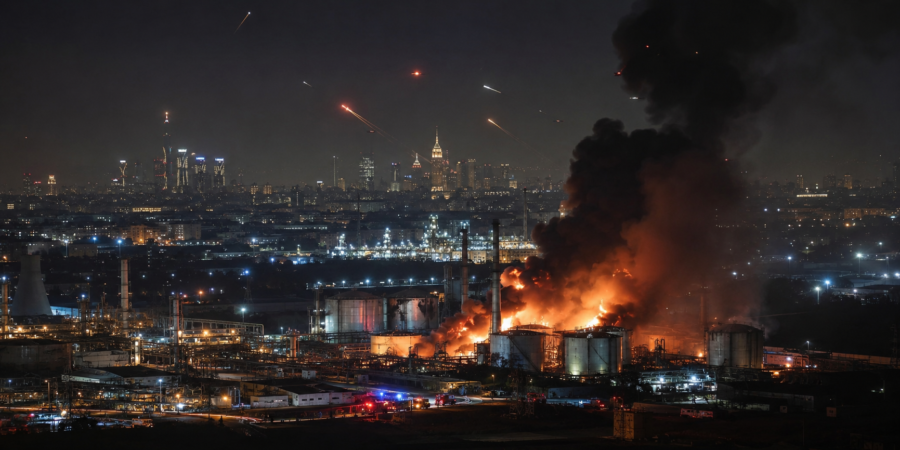
On 18 June 2026, Ukrainian drones struck the Gazprom Neft oil refinery in Moscow’s Kapotnya district for the second time in three days, damaging the Euro+ processing complex after an earlier strike had disabled the larger CDU-6 unit. Sixteen people were injured region-wide, Moscow airports briefly halted flights, and the attack is part of Kyiv’s wider “long-range sanctions” campaign against Russian oil infrastructure — pressure that has cut Russian crude output and diesel production without stopping Russian oil exports.
Two strikes in three days The Moscow refinery was hit on June 16 and attacked again on June 18 while repairs and restart preparations were underway.
16 injuries reported The Moscow regional governor reported 16 people injured during the wider drone raid around the Russian capital.
16 km from the Kremlin The refinery sits inside Moscow’s ring road, giving the strike unusual political and psychological weight.
Airports and roads disrupted Flights were suspended at Moscow airports, Sheremetyevo was evacuated and traffic stopped near the refinery.
What happened when Ukraine attacked Russia?
On June 18, 2026, a large Ukrainian drone operation targeted Moscow and surrounding areas. Several drones reached the Gazprom Neft Moscow oil refinery in Kapotnya, starting multiple fires and damaging the Euro+ refining complex, secondary processing units, inter-unit pipelines, supporting equipment and oil-product storage tanks. It was the second attack on the facility in three days.
Ukraine presented the wider campaign as retaliation for continuing Russian missile and drone strikes and as part of its “long-range sanctions” strategy against oil infrastructure that produces fuel and generates revenue for Russia. Moscow said many drones were intercepted, but the successful refinery strikes exposed limits in defending every strategic site around the heavily protected capital.
What happened over Moscow on June 18?
Ukrainian drones approached Moscow during a broad overnight and morning operation affecting several Russian regions. Russian authorities said air defences intercepted large numbers of unmanned aircraft. The complete launch and interception totals could not be independently verified, which is common during active wartime operations.
Despite the defensive response, several drones reached the refinery in southeast Moscow. Reuters reported an explosion powerful enough to throw the large disc-shaped lid of an oil-storage tank into the air. Video and images showed flames and thick black smoke above the facility.
The consequences quickly spread beyond the refinery. Commercial flights were suspended at Moscow airports, Sheremetyevo — the capital’s busiest airport — was evacuated and traffic stopped on a section of the ring road near the industrial site. Buildings elsewhere in the wider region were also reported damaged.
Moscow-region Governor Andrei Vorobyov said 16 people were injured during the wider attack. This is an official Russian figure and should be updated if subsequent investigations revise the total.
The raid was therefore not merely a distant explosion at an isolated industrial facility. It interrupted aviation, transport and daily life in a city of roughly 13 million people, making the conflict visible to residents who had previously experienced limited direct disruption.
For comparison, that scale of disruption is closer to what European travelers might recall from a single severe winter storm closing a major hub airport for a few hours — except triggered by an act of war rather than weather, and layered on top of an active fire at a fuel-processing site.
Why was the Moscow oil refinery such an important target?
The Gazprom Neft refinery is not merely a collection of storage tanks. It is a major processing complex serving Moscow and its surrounding region. Industry data cited by Reuters show that the plant processed approximately 11.6 million metric tons of crude oil in 2024, equivalent to around 230,000 barrels per day.
During that year, it produced approximately 2.9 million tons of gasoline, 3.2 million tons of diesel and 1.3 million tons of bitumen. These products support road transport, freight, construction, industry and the wider fuel-distribution system serving the Russian capital.
Refineries are particularly valuable targets because they are complex systems. Crude oil must pass through distillation, reforming, hydrotreating and other stages before it becomes usable petrol, diesel, aviation fuel or industrial products. Damage to a critical processing unit can interrupt the whole chain even when storage tanks and other buildings remain intact.
This complexity also makes repairs difficult. Large units often contain specialised furnaces, columns, compressors, pumps, control systems and high-pressure pipelines. Replacing or repairing them may require scarce components, expert labour and long shutdown periods — and Western sanctions on refining technology and spare parts have made sourcing replacement components considerably harder for Russian operators since 2022.
How the two attacks targeted both principal refining units
The sequence of damage is central to understanding the raid. On June 16, an earlier Ukrainian drone attack damaged CDU-6, one of the refinery’s two principal crude-distillation units. Reuters’ industry sources described CDU-6 as having a normal capacity of around 160,000 barrels per day — approximately 53% of the refinery’s total capacity.
The damage forced processing to stop. During repairs, the plant planned to restart its other main complex, Euro+, and operate at approximately half capacity. Euro+ was commissioned in 2020 as part of a major modernisation programme.
Euro+ contains a crude-distillation section with nominal capacity of about 140,000 barrels per day, representing roughly 47% of the refinery’s capacity. It also contains a catalytic reformer and diesel-hydrotreating equipment.
The June 18 attack then damaged Euro+. Industry sources also reported damage to secondary units, pipelines connecting different sections, auxiliary equipment and tanks containing oil products.
In strategic terms, the first attack disabled the larger primary unit. The second struck the alternative complex that was supposed to support a partial restart. This potentially increased the repair burden and reduced the refinery’s ability to compensate internally.
| Refinery section | Approximate capacity or purpose | Reported damage |
|---|---|---|
| CDU-6 | About 160,000 bpd; roughly 53% of refinery capacity | Damaged and caught fire during the June 16 attack |
| Euro+ complex | About 140,000 bpd; roughly 47% of capacity | Damaged in the June 18 attack while being prepared for restart |
| Secondary units | Upgrade and clean intermediate products | Additional damage reported by industry sources |
| Pipelines and storage | Move and store crude, intermediate and finished products | Pipelines, auxiliary systems and storage tanks damaged or set on fire |
Why did Ukraine attack Russia and choose this target?
Ukraine’s strategy has several connected objectives. The first is retaliation. Kyiv presented the attack as a response to continuing Russian missile and drone strikes on Ukrainian cities, including the June attack that badly damaged the historic Kyiv-Pechersk Lavra monastery complex. Russia denied deliberately striking the monastery.
The second objective is economic pressure. Oil and gas taxes account for a major share of Russia’s federal revenue. Even when attacks do not permanently destroy a refinery, shutdowns, repairs, reduced utilisation and emergency imports can raise costs and reduce the efficiency of the energy system.
The third objective is military logistics. Refined products such as diesel and aviation fuel support trucks, aircraft, generators, armoured vehicles and supply networks. Russia has a large energy system and can redirect fuel, but repeated disruption can increase transport distances, maintenance work and pressure on inventories.
The fourth objective is to stretch Russian air defences. Protecting the frontline is different from protecting hundreds of refineries, depots, pipelines, military factories, airports and power facilities spread across a vast country. Every additional defensive system positioned around Moscow or an oil installation is unavailable for another location.
The fifth objective is psychological. Striking critical infrastructure inside Moscow’s ring road challenges the idea that the capital can remain insulated from a war conducted against Ukraine. Airport closures, traffic disruption and smoke over the skyline create a direct domestic experience of the conflict.
Finally, Ukraine wants to demonstrate capability to its partners. Successful domestically produced long-range systems can show that Kyiv remains able to impose costs even when Russian forces retain advantages in other areas.
Ukraine’s “long-range sanctions” strategy
Ukrainian President Volodymyr Zelenskyy and other officials increasingly use the term “long-range sanctions” for military attacks on infrastructure connected to Russian oil production, refining, storage and transport.
The phrase is political as well as military. Traditional sanctions restrict trade, technology, finance and market access. Ukraine argues that physical attacks can reinforce that pressure by directly interrupting facilities generating fuel and revenue.
Ukraine’s presidential office said that Ukrainian forces struck 15 Russian refineries between January and May 2026. This is an official Ukrainian claim and does not mean that all 15 were permanently destroyed or completely shut down.
Official Ukrainian statements also identify refineries, storage facilities and other infrastructure linked to oil income as priority targets. Ukraine says longer-range systems now allow it to reach facilities hundreds of kilometres from its border.
This campaign attempts to create a cumulative effect. A single repaired refinery may return to operation, but simultaneous damage at several locations can compete for replacement parts, repair teams, air defences and logistical support.
How serious is the economic damage to Russia?
The economic impact is real, but exaggerated claims should be avoided. Russia remains one of the world’s largest oil producers and exporters, with a large network of refineries, pipelines, ports and storage facilities. It can redirect crude, draw on inventories, adjust exports and shift some refining to unaffected plants.
Nevertheless, the aggregate pressure has grown. Reuters reported in May that virtually all major refineries in central Russia had halted or reduced output after repeated Ukrainian drone attacks.
The combined capacity of the affected plants exceeded 83 million metric tons per year — around one quarter of Russia’s refining capacity. Those plants had accounted for more than 30% of Russian gasoline production and around 25% of diesel output.
Reuters’ analysis found Russian diesel production declined by approximately 10% in May after a similar monthly decline in April. Refineries hit by drones reduced diesel output by up to one million tons in April and up to a further 600,000 tons in May, according to the calculations.
The International Energy Agency reported that Russian crude production fell to 8.7 million barrels per day in May 2026, around 5% lower than a year earlier and 10% below that month’s target. The IEA attributed the decline to continued Ukrainian attacks and reduced its annual Russian crude forecast by 200,000 barrels per day.
The same data also show why simple claims of economic collapse would be misleading. Russian crude and refined-product exports remained around 7.4 million barrels per day in May. Oil-export revenue was reported at $20.8 billion, down $710 million from the previous month but still substantially higher than a year earlier.
The more accurate conclusion is that Ukrainian strikes are increasing costs, disrupting refinery operations, lowering some production indicators and forcing adaptations. They have not eliminated Russia’s ability to export oil or finance the war.
Fuel shortages, imports and the 19% petrol-price controversy
Russia’s refining pressure has begun producing unusual market responses. Reuters reported that Russia was preparing to import gasoline by sea in June to manage a looming shortage following months of attacks on refineries, pipelines and storage facilities.
Such an import is notable because Russia is normally one of the world’s leading exporters of oil and refined products. The expected cargo was reportedly to arrive through a western Russian port after shipment from Asia.
In Moscow, the Federal Antimonopoly Service requested an explanation from Neftmagistral after the retailer increased the price of 95-octane petrol from around 80 to 95 roubles per litre within one week — a rise of approximately 19%.
Neftmagistral operates around 100 stations in Moscow and the surrounding region. However, Reuters witnesses did not report widespread queues, and other large retailers listed considerably lower prices. Rosneft’s listed price was 73.6 roubles per litre on the same day.
Therefore, the 19% increase should not be described as a universal Moscow petrol-price increase. It concerned one chain and was questioned by the regulator. It is evidence of market anxiety and potential opportunistic pricing, not proof that the capital had completely run out of fuel.
How did drones reach one of Russia’s most defended cities?
Moscow is protected by layered air-defence, radar and electronic-warfare systems. Yet no defence network can guarantee that every small, low-flying or massed target will be detected and destroyed.
Ukraine may attempt to overwhelm defensive capacity by sending drones along several routes, at different altitudes or during a broader nationwide attack. Small unmanned aircraft can also be harder to detect than conventional combat aircraft or large missiles.
Electronic countermeasures may disrupt navigation, but some drones can use inertial guidance, terrain references, pre-programmed routes or other systems that reduce dependence on satellite signals.
The precise weapons, routes, launch sites and penetration methods used during the Moscow raid have not been publicly and independently established. Claims that a specific number of defensive “layers” were defeated should therefore be presented as attributed statements, not confirmed technical fact.
The confirmed strategic result is simpler: enough drones penetrated or survived the defensive response to damage the refinery twice in three days.
Russia’s response and the risk of retaliation
Russian officials emphasised the large number of drones they said had been intercepted and portrayed the raid as an attack on civilian and economic infrastructure. Moscow has repeatedly argued that Ukrainian attacks inside Russia reduce prospects for negotiations.
The Kremlin disputed Ukraine’s claim that the tide of the war was shifting in Kyiv’s favour. Russian officials maintain that battlefield developments and their military resources give Moscow the stronger long-term position.
Further Russian retaliation is possible. Previous Ukrainian attacks on Russian territory have been followed by missile and drone strikes against Ukrainian energy infrastructure, factories, military facilities and cities.
The escalation cycle creates a difficult problem. Ukraine argues that failing to answer Russian attacks would allow Moscow to strike without consequence. Russia uses Ukrainian strikes to justify further military action. Each side presents its operation as a response to the other.
This does not make the two sides’ responsibility for the conflict identical: Russia launched its full-scale invasion in February 2022. It does show why retaliatory operations can continue expanding even when both sides publicly discuss diplomacy.
Did the attack change the direction of the war?
The attack was strategically important, but it did not by itself decide the war. Territorial control, manpower, ammunition, industrial production, air defence, command systems and international support remain decisive factors.
Long-range strikes can impose costs without automatically creating immediate battlefield advances. A refinery shutdown may damage fuel supply and revenue, but it does not directly capture territory or remove Russian forces from Ukraine.
The raid does, however, show that Ukraine retains initiative in an important area of warfare. Domestically developed drones and missiles allow Kyiv to attack deep targets even when partner governments restrict the use of some foreign-supplied weapons.
It also forces Russia to solve a resource-allocation problem: defend the front, military bases and occupied territories, or move more air-defence and electronic-warfare systems toward cities, refineries and industrial sites far behind the front.
The most defensible conclusion is that the Moscow attack changed the cost and visibility of the war, but not yet its overall outcome.
Timeline: from the first refinery strike to the second
What could happen next?
The following are evidence-based scenarios, not confirmed predictions.
What readers should watch now
- Whether either CDU-6 or Euro+ resumes operation and at what capacity.
- Whether Russia publishes a repair schedule or revised fuel production data.
- Additional Ukrainian strikes on refineries, depots, ports, pipelines or military-production sites.
- Russian missile or drone retaliation against Ukrainian energy and urban infrastructure.
- New gasoline or diesel export restrictions and emergency fuel imports.
- Petrol-price changes outside one retailer and any evidence of wider queues or rationing.
- Changes in air-defence deployment around Moscow and other Russian industrial centres.
- Whether the escalation slows or accelerates diplomatic contacts.
What does this mean for civilians, students and travellers?
Civilians remain exposed on both sides of the conflict. Ukrainians continue experiencing frequent Russian missile and drone attacks, while deeper Ukrainian strikes increasingly expose Russian residents to injuries, damaged homes, transport disruption and fear.
Travellers using Moscow airports should monitor airline notifications closely. Drone alerts can result in rapid suspensions, diversions, evacuations and delays even when the airport itself is not physically struck.
International students and foreign residents should follow embassy guidance, local emergency instructions and official transport information. They should avoid approaching damaged infrastructure or photographing active defence operations.
Readers should also treat viral content carefully. Old footage, videos from other locations and unverified casualty claims are frequently recirculated during major attacks. Check the date, original uploader, visible landmarks and confirmation from several reliable sources before sharing.
Glossary of key terms
- CDU-6
- The larger of the Moscow refinery’s two crude-distillation units, with a normal processing capacity of about 160,000 barrels per day — the first stage that separates raw crude oil into lighter and heavier fractions.
- Euro+ complex
- A modernised refining unit commissioned in 2020 with a crude-distillation capacity of about 140,000 barrels per day, plus a catalytic reformer and diesel-hydrotreating equipment.
- “Long-range sanctions”
- A term used by Ukrainian officials, including President Zelenskyy, for military strikes on Russian oil and energy infrastructure intended to reinforce the economic effect of conventional financial sanctions.
- Kapotnya district
- The southeastern Moscow district, inside the city’s ring road, where the Gazprom Neft refinery is located — about 16 kilometres from the Kremlin.
Frequently asked questions
Why did Ukraine attack Russia and Moscow?
Was the Moscow refinery completely destroyed?
How close is the refinery to the Kremlin?
How many people were injured?
Is Russia experiencing a nationwide fuel collapse?
Did petrol prices rise by 19% across Moscow?
Will Russia retaliate?
Does the attack mean Ukraine is winning the war?
Conclusion: the strategic message behind the Moscow smoke
The latest Ukraine attacks Russia story is not simply about drones reaching Moscow. It reveals a deliberate strategy aimed at the industrial systems that turn Russian crude oil into usable fuel and state revenue.
The Moscow refinery combined economic, logistical, political and symbolic value. It supplied the capital, processed around 230,000 barrels per day in 2024 and stood only 16 kilometres from the Kremlin.
The timing made the second attack especially important. The first strike reportedly damaged the CDU-6 unit. As the plant prepared Euro+ to sustain partial production, the second raid damaged that complex and other supporting systems.
Ukraine is attempting to multiply the cost of Russia’s war by forcing repairs, redistributing fuel, stretching air defences and showing Russian citizens that the capital is not beyond reach.
Yet Russia’s energy economy remains large and adaptable. Exports continue, substantial revenue remains available and the strike does not automatically change the frontline. Claims of immediate Russian economic collapse are not supported by the available evidence.
The decisive questions are now whether the refinery can restart, whether Ukraine returns to the same or similar targets, how Russia reorganises its air defences and what form the next retaliation takes. The drones have already answered whether Moscow can be reached. The unanswered question is what happens after reaching it.
Sources and verification methodology
This article was prepared using Reuters reporting, energy-market data attributed to the International Energy Agency and official Ukrainian statements available on 19 June 2026. Military claims are attributed where independent verification remains incomplete.
- Reuters: Ukraine brings the war to Moscow as huge blasts shake the refinery
- Reuters: Second attack damages refinery units, pipelines and tanks
- Reuters: June 16 attack halts operations at the Moscow refinery
- Reuters: IEA reports Russian oil production 10% below the May target
- Reuters: Russian diesel output falls after refinery attacks
- Reuters: Central Russian refineries halt or reduce output
- Reuters: Russia prepares a rare gasoline import by sea
- Reuters: Regulator questions one retailer’s 19% petrol-price increase
- Reuters: Kyiv-Pechersk Lavra damaged during Russian attacks
- President of Ukraine: Official “long-range sanctions” position
Understand the story behind the breaking alert
Follow Scholar News Hub for carefully sourced global news, geopolitical explainers and updates affecting international students, researchers, travellers and families.