
2.067 million
Planned FY2026 active, Guard and Reserve military end strength, representing one of the world’s largest volunteer forces.
About $962 billion
FY2026 Defense Department program when discretionary and planned reconciliation funding are considered together — more than the combined defence budgets of the next ten countries.
Six domains
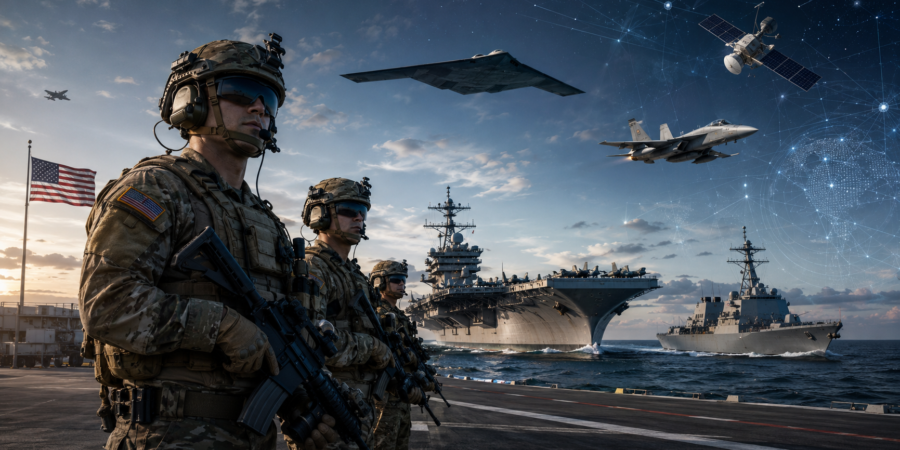
Land, sea, air, space, cyber and the electromagnetic spectrum operate as one connected force through joint all-domain command and control.
Three-part deterrent
Land-based missiles, ballistic-missile submarines and nuclear-capable bombers form the nuclear triad, ensuring second-strike capability.
What does the United States military have in 2026?
The US military operates six armed services within the Department of Defense—the Army, Navy, Air Force, Marine Corps, Space Force and their Reserve and National Guard components. The Coast Guard is a separate armed service under the Department of Homeland Security during normal peacetime operations but can operate with the Navy during war or when directed by the President.
Its publicly known capabilities include 11 nuclear-powered aircraft carriers, 50+ nuclear-powered submarines, stealth fighters and bombers, intercontinental ballistic missiles, the world’s largest military transport fleet, hundreds of aerial refuelling tankers, precision-guided weapons with GPS accuracy, space-based missile warning systems, dedicated cyber warfare units, special operations forces across all services, intelligence systems spanning multiple classification levels, and a global logistics network capable of moving equipment to any point on Earth within days. This combined force is designed to fight and win in multiple theatres simultaneously.
America’s real advantage is a system—not a single weapon
Public discussion often asks which country owns the fastest aircraft, largest missile or most powerful tank. That comparison misses the central feature of American military power. The United States has spent decades building a force in which sensors locate targets, satellites provide positioning and communications, aircraft refuel in flight, cargo fleets move equipment, cyber teams protect networks and commanders receive information from multiple domains simultaneously.
A fighter aircraft is more effective when supported by airborne radar, electronic warfare, intelligence, tankers, secure data links and precision munitions. A carrier becomes more powerful when accompanied by destroyers, submarines, supply ships, surveillance aircraft and a global maintenance system. An Army unit becomes more mobile when strategic airlift, pre-positioned equipment and allied ports are available. This systemic integration is the result of decades of investment in joint doctrine, interoperability standards and command-and-control architecture.
The Joint All-Domain Command and Control (JADC2) concept represents the next evolution of this approach—using artificial intelligence and advanced data networks to connect sensors from all services and domains in real time, allowing commanders to make decisions faster than adversaries can react. This is not a theoretical capability; it is being fielded incrementally across the force.
The most important American “weapon” may be the network that allows thousands of separate machines and units to act as one force across the planet—a distributed, resilient system that can absorb losses and continue operating.
The force behind the hardware: active, Guard and Reserve personnel
The FY2026 force plan projected approximately 1.303 million active-duty personnel and about 764,900 personnel in the Guard and Reserve, producing a total military end strength of roughly 2.068 million. These numbers do not include the large civilian workforce (approximately 750,000 direct-hire civilians), contractors or intelligence-community personnel who also support national defence. When all personnel categories are included, the total defence workforce exceeds 3 million.
The Reserve and National Guard are not merely emergency replacements. They contain combat aircraft, medical units, engineers, logistics specialists, cyber personnel, airlift, intelligence and civil-support capabilities. In a major conflict, the active force would depend heavily on them, particularly for sustainment and specialised technical skills. The National Guard also maintains a critical homeland-security and disaster-response role, frequently deploying during domestic emergencies.
Personnel readiness is a persistent challenge. Recruiting and retention have faced headwinds in recent years, with only about 30% of eligible youth meeting the physical and educational standards for service. The services have responded with enhanced incentives, increased marketing and revised standards for certain roles.
| Component | FY2026 planned strength | Primary role |
|---|---|---|
| Active Army | 454,000 | Large-scale land combat, air defence, logistics and global ground presence |
| Active Navy | 344,600 | Sea control, submarines, carriers, maritime strike and nuclear deterrence |
| Active Marine Corps | 172,300 | Rapid expeditionary operations, amphibious warfare and forward presence |
| Active Air Force | 321,500 | Air superiority, strike, transport, tankers, surveillance and nuclear missions |
| Active Space Force | 10,400 | Space operations, satellite control, missile warning and orbital awareness |
| Guard and Reserve | 764,900 | Reinforcement, specialised capabilities, homeland missions and mobilisation depth |
US Army: far more than tanks and infantry
The Army remains the largest service and supplies the bulk of America’s sustained land-combat power. Its most recognizable systems include M1A2 Abrams tanks (approximately 2,500 in active inventory), Bradley fighting vehicles, Stryker vehicles, AH-64 Apache attack helicopters (over 600), UH-60 Black Hawk utility helicopters, CH-47 Chinook heavy-lift helicopters and M142 HIMARS multiple rocket-launch systems. The Army also operates the M777 lightweight towed howitzer and the M109 Paladin self-propelled artillery.
Yet the Army’s less-visible capabilities are equally important: Patriot and THAAD missile defence systems, engineering brigades capable of constructing airfields and bridges under fire, battlefield intelligence and electronic warfare units, secure communications networks, water purification systems, medical evacuation helicopters and field hospitals, fuel distribution pipelines, and large logistics formations capable of supporting entire corps-sized forces. These capabilities allow other forces to survive and operate after arriving in a theatre.
The Army is also developing the XM30 infantry fighting vehicle to replace the Bradley, the M1E3 Abrams modernisation concept, new precision fires including the Precision Strike Missile (PrSM), robotic combat vehicles, counter-drone technologies and a larger munitions-production base. The service is also investing heavily in hypersonic weapons through its Long-Range Hypersonic Weapon (LRHW) program, which is intended to provide a rapid, precision-strike capability against high-value targets. Its modernization challenge is to introduce new systems while keeping older equipment ready for current operations.
US Navy: mobile airfields, invisible submarines and global sea power
The Navy’s 11 nuclear-powered aircraft carriers (with the USS Gerald R. Ford as the lead ship of the newest class) function as mobile airbases capable of projecting power anywhere in the world. Each carrier can operate up to 80 aircraft and provides around-the-clock flight operations for weeks at a time. A carrier does not normally operate alone; it forms the centre of a strike group that may include guided-missile destroyers (Arleigh Burke and Zumwalt classes), cruisers (Ticonderoga class), attack submarines (Los Angeles, Virginia and Seawolf classes), logistics ships and an embarked air wing consisting of F/A-18 Hornets, F-35C Lightning IIs, EA-18G Growlers, E-2D Hawkeyes and MH-60 helicopters. This network provides air defence, strike, anti-submarine warfare, surveillance and sea control.
Submarines are among the Navy’s most strategically important assets. Fourteen Ohio-class ballistic-missile submarines form the sea-based portion of the nuclear triad. Each can carry up to 20 Trident II D5 missiles under current configuration, each missile capable of delivering multiple independently targeted warheads. Attack submarines hunt other submarines and ships, collect intelligence and can launch cruise missiles. The Virginia-class attack submarines, with their Tomahawk cruise-missile payload capacity and advanced sensors, are the workhorses of the undersea force, with approximately 30 in service and more under construction.
Four converted Ohio-class guided-missile submarines (SSGNs) provide a capability unfamiliar to many readers. Each can carry as many as 154 Tomahawk cruise missiles and support special operations forces. Their large payload and underwater concealment make them powerful conventional strike platforms. These vessels also host advanced communications systems that enable them to support covert operations.
The Navy is currently building a new class of ballistic-missile submarines—the Columbia class—which is scheduled to replace the Ohio class beginning in the early 2030s. At approximately $9 billion per ship, this is the most expensive shipbuilding program in American history. The service is also developing new unmanned underwater vehicles (UUVs), including the Orca extra-large UUV, which can conduct mine countermeasures, surveillance and potentially strike missions.
US Air Force: the aircraft people notice—and the enablers they miss
The Air Force operates a diverse fighter fleet including approximately 185 F-22 Raptors (the premier air-superiority fighter), over 300 F-35A Lightning IIs (with more on order), and large numbers of F-15E Strike Eagles and F-16 Fighting Falcons. The service also operates strategic and conventional bombers including 58 B-52H Stratofortresses, 45 B-1B Lancers and 20 B-2 Spirit stealth bombers. The B-21 Raider is entering the future force as a stealth bomber designed for contested environments and both conventional and nuclear missions, with initial operational capability expected in the 2026-2027 timeframe.
Tankers are one of the most important capabilities that rarely receive public attention. The Air Force operates approximately 400 KC-135 Stratotankers and over 50 KC-46 Pegasus tankers, with more KC-46s being delivered. These aircraft can refuel fighters, bombers and other aircraft in flight, extending their range by thousands of miles. This capability allows American aircraft to operate from bases far from conflict zones while remaining on station for extended periods. Without tankers, the Air Force’s global reach would be severely constrained.
Strategic airlift provides another hidden advantage. The Air Force operates approximately 275 C-17 Globemaster IIIs and over 50 C-5M Super Galaxies. These aircraft move troops, vehicles, helicopters and equipment between continents. The C-130 Hercules, with approximately 300 in service, provides tactical transport into more austere locations. Without these fleets, rapid global deployment would be far more difficult, if not impossible. The Air Force also operates specialised platforms such as the E-3 Sentry AWACS for airborne early warning and control, the RC-135 Rivet Joint for signals intelligence, and the U-2 Dragon Lady for high-altitude reconnaissance.
Marine Corps: a rapidly deployable force built to operate forward
The Marine Corps combines infantry, artillery, aviation, logistics and command elements into expeditionary forces that can deploy aboard Navy amphibious ships. Marine units can respond to crises, evacuate civilians, seize or defend key locations and establish an initial presence before larger forces arrive. The Corps maintains three active divisions and one reserve division, with a total of approximately 172,000 active Marines.
The service is transforming for operations across the Indo-Pacific under the Force Design 2030 concept. New concepts emphasise smaller distributed units, anti-ship missiles (such as the Naval Strike Missile), sensors, drones and the ability to move between islands while supporting naval operations. Medium Landing Ships (the new Landing Ship Medium class) are intended to help transport forces in this distributed environment, though this program has faced development challenges.
Marine aviation includes F-35B and F-35C variants, AV-8B Harriers (being phased out), CH-53E Super Stallion and CH-53K King Stallion helicopters, MV-22 Osprey tilt-rotor aircraft, UH-1Y Venom and AH-1Z Viper helicopters, and KC-130J Hercules aerial-refuelling/transport aircraft. This gives expeditionary formations their own air support, mobility and reconnaissance rather than making them completely dependent on another service.
Space Force: the invisible layer supporting almost everything
The Space Force is small in personnel (approximately 10,400 active) but enormous in strategic importance. Military satellites support positioning, navigation and timing (PNT) through the GPS constellation (approximately 31 operational satellites), secure communications via the Wideband Global SATCOM and other systems, weather monitoring, missile warning through the Space-Based Infrared System, and intelligence, surveillance and reconnaissance. GPS, operated by the Space Force, is also deeply embedded in civilian transport, finance, telecommunications and emergency services—making it a critical national asset.
Missile-warning satellites detect launches and provide early information to commanders and national leaders—a capability that is vital for both tactical warning and strategic deterrence. Space-domain awareness systems track satellites, debris and potentially threatening activity in orbit. Protected communications connect forces operating beyond the reach of ordinary terrestrial networks. The Space Force is also responsible for the command and control of all military space operations.
This dependence also creates vulnerability. US military operations could become slower and less precise if satellites, ground stations or data links were disrupted. China and Russia are developing counter-space systems intended to interfere with or damage space-enabled capabilities, including kinetic ASAT weapons, electronic jammers and directed-energy systems. The Space Force is consequently investing in resilient architectures, including proliferated low-Earth orbit constellations (such as the Space Development Agency’s transport layer), rapid launch capabilities and defensive measures to protect satellite assets.
The Space Force also operates a network of ground-based sensors for space surveillance, including the Space Fence radar system and the Space Surveillance Network, which tracks over 40,000 objects in orbit—approximately 20,000 of which are active satellites.
Cyber Command: operations conducted through code and networks
US Cyber Command (USCYBERCOM) defends military networks, supports combatant commands and conducts authorised cyberspace operations. Its Cyber National Mission Force (CNMF) is responsible for defending the nation against significant malicious cyber activity and for disrupting adversary actors when directed. The CNMF includes teams from all services and operates at a high operational tempo, with a focus on both defensive and offensive cyber operations.
Cyber power is difficult to display in a parade. It may involve identifying intruders, protecting command networks, collecting intelligence, disrupting malware infrastructure or supporting conventional military operations. The command has conducted a number of publicly acknowledged operations, including the disruption of Russian state-sponsored malware campaigns and the hardening of military networks against foreign intrusion. Artificial intelligence is being incorporated to improve analysis, scale operations and accelerate the detection of threats.
Each service also maintains its own cyber component, integrated into USCYBERCOM. The Army, Navy, Air Force and Marine Corps all operate dedicated cyber units that support both their service-specific missions and joint operations. The total cyber workforce (military and civilian) is estimated at over 15,000 personnel, with more being recruited and trained.
Special Operations Command: not one secret unit, but a joint ecosystem
US Special Operations Command (SOCOM) brings together specialised forces from the Army, Navy, Air Force and Marine Corps. Publicly known organisations include Army Special Forces (Green Berets), Rangers, special operations aviation (160th SOAR), Navy SEALs, Air Force special tactics and combat controllers, and Marine Raiders. SOCOM also operates a dedicated intelligence and logistics apparatus.
The FY2026 plan listed approximately 62,600 active military personnel within SOCOM-related end strength, alongside full-time reservists and civilians. This represents a substantial increase from earlier years, reflecting the growing importance of special operations in irregular warfare and counterterrorism.
Their missions include special reconnaissance, counterterrorism, partner-force training, unconventional warfare, information support and precision operations. SOCOM operates globally, with a presence in more than 70 countries. The less visible advantage is specialised support: intelligence analysts, language experts, aviation, communications, medical personnel and logistics units. High-profile operators represent only one part of a much larger structure.
SOCOM also maintains its own fleet of specialised aircraft, including the MC-130J Commando II (infiltration/exfiltration), AC-130J Ghostrider (close air support), and CV-22 Osprey tilt-rotor aircraft. These platforms are designed specifically for the unique requirements of special operations—short runways, low-level flight and covert insertion.
The nuclear triad: deterrence through three different pathways
The United States maintains land-based Minuteman III intercontinental ballistic missiles (approximately 400 deployed in silos across the Great Plains), Ohio-class ballistic-missile submarines carrying Trident II D5 missiles (14 submarines, each with 20 missiles), and nuclear-capable bombers (B-52s and B-2s). The purpose of maintaining three legs is to make it extremely difficult for any adversary to eliminate the nuclear force in a first strike—ensuring a credible second-strike capability that underpins deterrence.
Independent researchers at the Federation of American Scientists estimated in 2025 that the United States maintained a military stockpile of approximately 3,700 nuclear warheads, with about 1,700 deployed (on missiles and bombers) and the remainder in reserve or awaiting dismantlement. Exact operational details remain classified, so public numbers are estimates rather than a complete official inventory.
Every leg of the triad is being modernised. Sentinel (formerly known as Ground-Based Strategic Deterrent) is intended to replace Minuteman III with new ICBMs, the Columbia class will replace Ohio-class ballistic-missile submarines (with construction already underway), and the B-21 Raider will join the bomber force. The scale, cost and schedule of this recapitalisation make it one of the largest defence projects in American history, with total costs estimated at over $1 trillion over the next three decades.
The capability most countries cannot easily copy: global logistics
The United States can move forces across oceans because it combines transport aircraft, military cargo ships (including the 60-ship sealift fleet), commercial partners, overseas facilities, pre-positioned stocks and logistics commands. Equipment can be stored near likely areas of operation before a crisis begins, reducing the amount that must be moved after war starts. The US maintains pre-positioned stocks in ships at sea and in land-based sites in various theatres, including Europe, the Middle East and the Pacific.
Sealift is essential because aircraft are fast but cannot move the same volume of tanks, ammunition, fuel and heavy equipment as ships. Military Sealift Command and the reserve sealift fleet provide cargo, fuel and replenishment capacity. Commercial shipping and aviation can also be contracted or activated under national programmes such as the Civil Reserve Air Fleet (CRAF) and the Voluntary Intermodal Sealift Agreement (VISA). In a major conflict, the Department of Defense would draw heavily on these commercial assets.
The logistics system is also supported by a network of overseas bases. The United States maintains approximately 750 military bases in more than 80 countries, providing access for airlift, sealift and power projection. Key hubs include Ramstein Air Base in Germany, Yokota Air Base in Japan, Andersen Air Force Base in Guam, and Naval Support Activity Bahrain. These bases provide the infrastructure needed to sustain global operations.
Winning the first battle means little if fuel, spare parts, food, medical supplies and ammunition cannot continue arriving. Logistics is the true determinant of sustained military effectiveness.
This system is powerful but not invulnerable. Aging sealift ships (many from the 1970s and 1980s), contested ports, cyberattacks, submarines, long-range missiles and disrupted supply chains could all slow deployment. Logistics would become a major target in any conflict with a technologically advanced opponent. The Department of Defense has identified logistics resilience as a top priority in recent strategic reviews.
Intelligence and alliances multiply American power
American forces benefit from satellites, surveillance aircraft, underwater sensors, signals intelligence, cyber collection and information shared by allies. The US Intelligence Community, comprising 18 agencies including the CIA, NSA and DIA, provides multi-domain intelligence that supports both strategic planning and tactical operations. Intelligence reduces uncertainty, helps identify threats and allows commanders to allocate scarce weapons more effectively.
Alliances are another capability that cannot be counted like aircraft. NATO members, Japan, South Korea, Australia and other partners provide bases, ports, airspace, intelligence, logistics, local knowledge and military forces. These relationships expand access and complicate an adversary’s planning. The Five Eyes intelligence-sharing arrangement (US, UK, Canada, Australia, New Zealand) provides a global intelligence network that is unmatched by any other alliance.
The United States also maintains bilateral and multilateral defence agreements that allow for combined exercises, interoperability standards and co-development of military technology. These relationships are not static; they are continuously managed through diplomatic and military engagement. The AUKUS partnership (Australia, UK, US) represents a recent example of this deepening cooperation, focusing on nuclear-powered submarines and advanced technology.
Dependence on partners also imposes limits. Allies may disagree over a conflict, restrict the use of bases or apply different legal conditions. Coalition warfare requires diplomacy, interoperability and political trust—not only military hardware. The US military’s ability to operate effectively with allied forces depends on decades of shared training, doctrine and standards.
Medical care, repair depots and factories: the machinery behind survival
The Military Health System maintains personnel health and prepares for wartime treatment, evacuation and rehabilitation. Medical units can move casualties from the battlefield through increasingly advanced levels of care—from frontline medics to field hospitals to advanced trauma centres in rear areas to military medical centres in the United States. Survival depends not only on battlefield medicine but also on transport aircraft (the C-17 and C-130 are often used for medical evacuation), hospitals, blood supplies and trained teams. The military operates its own blood-bank system and maintains significant stockpiles of medical supplies.
Maintenance depots repair aircraft, ships, vehicles, electronics and weapons. These depots are located across the United States and in some overseas locations, providing a distributed repair capability that can return damaged equipment to service. Government arsenals and private companies produce missiles, ammunition, engines, ships and software. This industrial system determines how quickly losses can be replaced and how long the country can sustain a demanding conflict.
Recent wars have exposed the importance of production volume. A technically advanced weapon cannot influence a prolonged war if stockpiles are too small or factories cannot replace expenditure quickly. The FY2026 budget therefore placed strong emphasis on munitions production, shipbuilding and the defence industrial base. The Department of Defense has also established the Office of Strategic Capital to help finance and accelerate production of critical defence technologies.
The industrial base faces challenges, including a shrinking supplier network, skilled-labour shortages and long lead times for certain components. These vulnerabilities have been highlighted in multiple GAO reports, which note that many critical components rely on single suppliers or foreign sources. The Department is actively working to increase resilience and redundancy in the supply chain.
Emerging technologies: AI, hypersonics, directed energy and autonomous systems
The US military is actively investing in several emerging technology areas that are expected to reshape the character of warfare in the coming decade. Artificial intelligence and machine learning are being integrated into command and control systems, intelligence analysis, logistics planning and autonomous platforms. The Department of Defense has established the Chief Digital and Artificial Intelligence Office to coordinate AI development across the services.
Hypersonic weapons—systems that travel at speeds greater than Mach 5—are a major priority. The Army’s Long-Range Hypersonic Weapon, the Navy’s Conventional Prompt Strike, and the Air Force’s Air-Launched Rapid Response Weapon are all in development. These systems are designed to defeat ballistic-missile defences and strike time-sensitive targets with unprecedented speed. However, hypersonic technology remains challenging, with development delays and test failures reported in some programs.
Directed-energy weapons—lasers and high-powered microwaves—are being developed for applications including counter-drone defence, missile defence and anti-ship warfare. The Navy has deployed the HELIOS laser system on some destroyers, and the Army is testing laser-equipped Stryker vehicles. While these systems have not yet reached maturity, they promise lower cost-per-shot and unlimited ammunition compared to kinetic weapons.
Autonomous systems, including unmanned aerial vehicles, unmanned surface and underwater vessels, and robotic ground vehicles, are proliferating across all services. The Air Force’s Collaborative Combat Aircraft (CCA) program envisions drone “wingmen” that operate alongside manned fighters, providing additional sensors and weapons at lower cost. The Navy is developing unmanned surface vessels for mine countermeasures and surveillance. These systems offer the potential to reduce risk to human personnel while increasing operational reach.
The uncomfortable truth: enormous power does not remove serious weaknesses
The United States has unmatched breadth, but it is not invulnerable. Government oversight reports (including those from the GAO and the Department of Defense Inspector General) identify persistent readiness, maintenance and production problems. Some weaknesses arise precisely because the force is so large, technologically complex and globally committed. The following challenges have been identified in multiple official assessments:
The 2026 threat environment: peer competitors and asymmetric challenges
The US military in 2026 operates in a strategic environment defined by the return of great-power competition. China and Russia are the primary peer competitors, both investing heavily in military modernisation and developing capabilities specifically designed to challenge American advantages. China’s People’s Liberation Army is the largest military in the world by personnel and is rapidly closing the technological gap in areas such as hypersonic weapons, stealth technology and cyber warfare.
Russia, despite the strain of its ongoing war in Ukraine, remains a significant military power with extensive nuclear forces, advanced air-defence systems (S-400, S-500), and sophisticated electronic-warfare and cyber capabilities. The war in Ukraine has provided both the US and its adversaries with real-world lessons about the character of modern conflict, including the importance of artillery, drones, logistics and civilian infrastructure resilience.
Beyond the major powers, the US faces threats from regional actors such as Iran and North Korea, as well as non-state actors including terrorist organisations and criminal networks. These threats are diverse in character, ranging from conventional military conflict to terrorism, cybercrime and information warfare. The US military must therefore maintain capabilities across the full spectrum of conflict.
The 2022 National Defense Strategy, which continues to guide policy in 2026, identifies China as the “pacing challenge”—the primary competitor against which US capabilities must be measured. This has led to a reorientation of forces toward the Indo-Pacific region, with increased investment in naval, air and space capabilities designed to operate in contested environments far from US shores.
Fifteen overlooked facts about American military power
- Aerial-refuelling aircraft often determine whether fighters and bombers can reach distant targets—without them, global reach is severely limited.
- GPS timing supports financial networks and civilian infrastructure as well as military navigation—it is a national critical infrastructure.
- Reserve and National Guard forces operate advanced aircraft, cyber units, medical commands and major logistics capabilities—they are not “backup” forces.
- Four guided-missile submarines (SSGNs) can each carry up to 154 Tomahawk cruise missiles—a conventional strike capability that is often overlooked.
- Military power depends heavily on civilian shipyards, software companies, manufacturers and commercial transport—the defence industrial base is a critical strategic asset.
- Water purification, fuel distribution and repair units may determine how long a deployed force survives—these are essential enabling capabilities.
- The smallest service, the Space Force, supports capabilities used by nearly every other service—and is the most rapidly evolving.
- Overseas access depends on political agreements and allied consent, not only American military strength—diplomacy is a core component of military strategy.
- A platform listed in the inventory may not be immediately deployable because of maintenance, training or parts shortages—inventory is not the same as readiness.
- The decisive contest in a prolonged war may be industrial production and logistics rather than the first dramatic attack—sustainability matters as much as initial capability.
- The US military maintains bases on every continent except Antarctica, providing global operational reach.
- The Department of Defense is one of the largest organisations in the world by budget, personnel and physical footprint.
- The military operates its own banking system, postal service, schools, hospitals and legal system—it is a society within a society.
- Many advanced technologies, including the internet, GPS, and the semiconductor industry, received early funding or development through military research programs.
- The military has conducted humanitarian and disaster-response operations in every major natural disaster in recent history, demonstrating that military capabilities have peacetime applications.
What the US military is building next
Modernisation is focused on several major programs: the B-21 Raider stealth bomber (now in flight testing), Columbia-class ballistic-missile submarines (under construction), Sentinel intercontinental ballistic missiles (in development), next-generation combat aircraft (the Air Force’s NGAD and the Navy’s F/A-XX programs), autonomous systems (including collaborative combat aircraft), hypersonic weapons, counter-drone systems, more resilient satellite constellations (including the SDA’s proliferated LEO architecture), artificial intelligence integration, expanded munitions production and improved missile defence systems.
The central design problem is balancing exquisite technology with affordable mass. A small number of advanced platforms may be highly capable but vulnerable to attrition or saturation. Future forces are therefore exploring combinations of crewed platforms, less-expensive autonomous systems and distributed sensors that can be mass-produced. This “affordable mass” approach recognises that numerical advantage still matters in major-power conflict.
The Department of Defense is also investing in the research and development base, with funding for basic research, applied technology and prototyping. The goal is to maintain a technological edge while also ensuring that new capabilities can be produced in sufficient quantities to matter in a conflict.
Success will depend on whether programmes can be delivered on time, whether factories can produce sufficient quantities and whether the services can train personnel to operate increasingly software-dependent systems. The historical record shows that major modernisation programs often experience delays and cost overruns, making this a critical management challenge for the Department.
Frequently asked questions about US military capabilities
Is the United States military the largest in the world?
How many people serve in the US military?
What is America’s strongest military capability?
How many nuclear weapons does the United States have?
Does the United States have secret weapons?
What are the biggest weaknesses of the US military?
How does the US military compare to China’s military in 2026?
What is JADC2 and why does it matter?
Conclusion: American power is strongest where the public rarely looks
Understanding US military capabilities in 2026 requires looking beyond dramatic images of fighters, carriers and tanks. Those platforms matter, but they become globally effective because of refuelling aircraft, cargo fleets, satellites, cyber teams, intelligence networks, Reserve forces, repair depots, medical systems, allied access and industrial production. The integration of these capabilities into a single, joint warfighting system is what distinguishes the US military from almost every other force on the planet.
The same complexity creates risk. Advanced systems require maintenance, secure networks, specialised personnel, spare parts and vast quantities of fuel and ammunition. Shipbuilding delays, aging logistics assets and stretched production capacity show that even the world’s best-funded military must make difficult choices. The military’s ability to sustain operations in a prolonged high-intensity conflict is the central question facing defence planners in 2026.
The most accurate conclusion is therefore neither that the United States is unbeatable nor that expensive weapons are meaningless. Its real strength is the ability to connect many different capabilities at global scale—a systemic advantage that requires constant investment, maintenance and adaptation. Its greatest challenge is keeping that enormous system ready, supplied and resilient during a prolonged high-intensity conflict while also modernising for future threats.
As the global security environment continues to evolve, the US military will be tested not only by its equipment and technology but by its ability to adapt, innovate and sustain the comprehensive system of capabilities that underpins its power. Understanding this system—and its vulnerabilities—is essential for anyone seeking to comprehend the full scope of American military strength in 2026.
Sources and research methodology
This guide uses publicly available US Defense Department, service, GAO, Cyber Command, Space Force and independent nuclear-research sources. It does not claim access to classified systems, secret deployment plans or protected operational information. Personnel and budget figures can change through congressional legislation and subsequent execution. All figures are accurate as of June 2026 based on the most recent official publications.
- US Department of Defense: FY2026 budget request and military end strength
- US Defense Department: FY2026 budget priorities and service allocations
- Government Accountability Office: military readiness challenges
- GAO: Navy shipbuilding and repair delays
- US Navy: Ohio-class ballistic-missile submarine fact file
- US Navy: guided-missile submarine capabilities
- US Defense Department: America’s nuclear triad
- Federation of American Scientists: estimated US nuclear stockpile
- United States Cyber Command: mission and current activities
- United States Space Force: space threats and military dependence
- US Army: official website and fact files
- US Air Force: official website and fact sheets
- US Special Operations Command: official website
Understand global power beyond headlines and viral videos
Follow Scholar News Hub for deeply researched global-security explainers, international news, education opportunities and developments affecting students, researchers and travellers. Our analysis is grounded in official sources and independent research.