
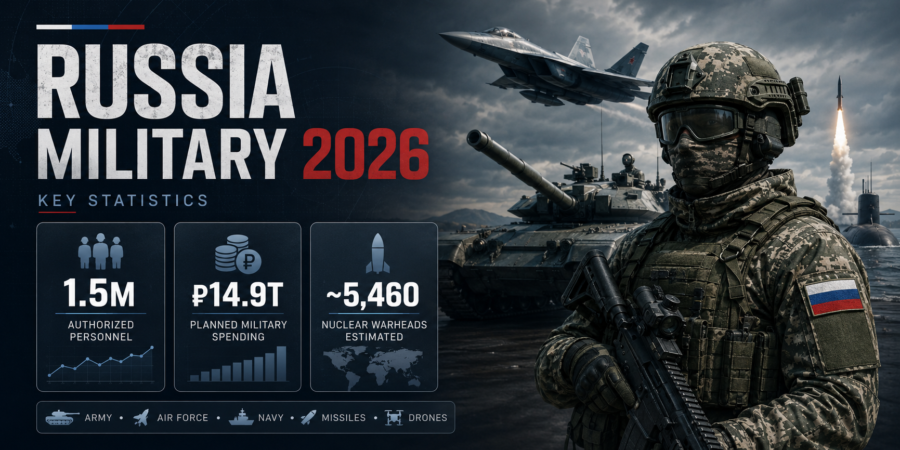
1.5 million
Authorised military personnel ceiling – not independently verified operational strength.
₽14.9 trillion
SIPRI estimate of planned Russian military expenditure for 2026.
About 5,460
Estimated total nuclear‑warhead inventory, including stored and retired weapons.
Multi‑domain force
Ground, air, naval, nuclear, space, cyber, drone and electronic warfare capabilities.
Direct Answer
What military capabilities does Russia have in 2026?
Russia possesses large Ground Forces, Aerospace Forces, a
submarine‑centred Navy, independent Strategic Missile Forces,
Airborne Troops, special operations units and an emerging
separate Unmanned Systems force. It maintains strategic and
non‑strategic nuclear weapons, long‑range ballistic and cruise
missiles, layered air defence, artillery, armoured formations,
electronic warfare, military satellites, cyber capabilities and
an expanded wartime defence industry.
Its operational power is difficult to measure from inventory
numbers alone. Thousands of systems have been destroyed, damaged
or worn down since 2022, while stored Soviet equipment has been
refurbished and new production has increased. Public figures
therefore mix authorised formations, functioning equipment,
reserve stocks and systems undergoing repair.
What is confirmed, estimated and unknown?
| Area | What public evidence supports | Important limitation |
|---|---|---|
| Personnel | Authorised ceiling of 1.5 million military personnel. | Authorised strength is not proof that all posts are filled by trained and equipped personnel. |
| Military spending | Approximately ₽14.9 trillion planned for 2026 under SIPRI’s wider definition. | Budgets can be amended and a large proportion of expenditure is classified. |
| Nuclear weapons | FAS estimates nearly 5,460 total warheads and about 1,718 deployed. | Russia does not publish a complete current inventory. |
| Conventional equipment | Russia operates large families of tanks, aircraft, missiles, ships, artillery and drones. | Operational availability is obscured by losses, repairs, storage and secrecy. |
| Classified capabilities | Some cyber, space, intelligence and weapons programmes are secret. | Online claims about “unknown superweapons” should not be presented as established facts. |
How Russia’s military is organised
The Russian Armed Forces are structured around three principal services—Ground Forces, Aerospace Forces, and Navy—with the Strategic Missile Forces and Airborne Troops (VDV) holding independent service‑arm status. Special Operations Forces, military intelligence (GRU), logistics and railway troops provide specialised support.
Additional armed formations exist outside the Ministry of Defence. Rosgvardiya (National Guard) handles internal security, occupation duties and rear‑area control, while the FSB Border Service secures frontiers. These forces are not part of the regular military establishment and should not be counted as deployable combat troops.
In 2024, the Moscow and Leningrad Military Districts were re‑established, joining the Southern, Central and Eastern districts. This realignment focused attention on the western and north‑western frontiers following NATO expansion and the prolonged war in Ukraine.
Personnel: larger numbers do not automatically mean a better force
A presidential decree raised the authorised military component to 1.5 million personnel within a total Armed Forces establishment of approximately 2.39 million positions, including civilian staff. This was the third increase since the full‑scale invasion of Ukraine.
The expansion aims to replace wartime losses, create new formations, strengthen the NATO frontier, protect occupied territories and sustain a long war. Recruitment relies on contracts, conscription, regional incentives and mobilisation mechanisms.
The critical uncertainty is quality. A force can grow numerically while losing experienced junior leaders, specialists and instructors. NATO assessments indicate that Russia’s land forces became larger than in February 2022 but declined in average quality, with new personnel requiring time to reach proficiency.
Russia’s military budget and wartime economy
SIPRI estimates that Russia spent approximately $190 billion on the military in 2025, equivalent to around 7.5 % of GDP. Under the 2026 budget, planned total military expenditure falls to roughly 14.9 trillion roubles, or 6.3 % of GDP and 34 % of total federal expenditure.
The apparent decline does not signal rapid demilitarisation. Spending remains historically high, previous budgets have been amended during the year, and war costs can be dispersed across defence, security, social payments, regional recruitment bonuses and occupied‑territory programmes.
Defence industries have received priority access to labour, credit and state orders. Civilian sectors face high interest rates, worker shortages, inflation and reduced access to imported technology. The military system has therefore become more productive in selected areas while placing growing pressure on the wider economy.
Russia has demonstrated that it can finance prolonged war,
but every additional year increases pressure on revenue,
labour, civilian investment and future economic growth.
Ground Forces: tanks, artillery and battlefield mass
The Ground Forces are built around motorised‑rifle, tank, artillery, missile, air‑defence, engineering and logistics formations. The force combines newer equipment with upgraded Soviet designs and vehicles returned from long‑term storage.
Prominent tank types include the T‑90M, modernised T‑72B3 and T‑80BVM. Infantry formations use BMP and BTR families alongside newer vehicles and improvised protection. Heavy losses have forced Russia to recover older T‑62 and T‑55‑series vehicles for selected roles, illustrating the depth yet declining average quality of its equipment pool.
T‑90M, T‑72B3, T‑80BVM, BMP and BTR vehicle families.
Tube artillery, mortars, Tornado rocket systems and large ammunition expenditure.
Iskander‑M ballistic and cruise‑missile capabilities for theatre‑level strikes.
Buk, Tor, Pantsir, portable systems and electronic countermeasures.
Russia retains a strong tradition of massed fires. Artillery is increasingly connected to reconnaissance drones and electronic detection, enabling faster targeting cycles. The result is not always elegant combined‑arms manoeuvre, but it generates sustained battlefield pressure.
Aerospace Forces: combat aviation and layered air defence
The Aerospace Forces (VKS) combine the Air Force, Air and Missile Defence Forces, and Space Forces. Combat aviation includes Su‑35S and Su‑30SM fighters, Su‑34 strike aircraft, MiG‑31 interceptors, and a limited number of Su‑57 low‑observable fighters.
Long‑range aviation operates Tu‑95MS and Tu‑160 strategic bombers, as well as Tu‑22M3 aircraft. These platforms launch cruise missiles or stand‑off weapons from outside the densest air‑defence zones, preserving their survivability.
A game‑changing adaptation has been the mass use of guided glide bombs. Conventional bombs fitted with wings and navigation kits allow aircraft to release heavy weapons from greater distance without flying directly over the front line. These weapons are cheaper than cruise missiles and can be used at high volume.
Russia also operates S‑400, S‑350 and older S‑300‑family systems, together with Buk, Tor and Pantsir defences. This layered network is extensive, but no air‑defence system provides complete protection. Ukrainian missiles and drones have repeatedly penetrated defended areas and damaged strategic targets.
Russian Navy: submarines remain more important than the surface fleet
Russia maintains the Northern, Pacific, Baltic and Black Sea fleets and the Caspian Flotilla. Geography divides naval forces across distant theatres, making concentration difficult and placing heavy importance on protected bases, submarines and long‑range missiles.
Borei and Borei‑A ballistic‑missile submarines carry Bulava strategic missiles and form a modernising part of Russia’s nuclear deterrent. Yasen and Yasen‑M nuclear‑powered attack submarines are designed for anti‑ship, anti‑submarine and land‑attack missions using weapons such as Kalibr and Oniks.
The surface fleet includes Admiral Gorshkov‑class frigates, older cruisers and destroyers, corvettes, landing ships and missile craft. Some newer ships can carry Kalibr cruise missiles and, in selected cases, Zircon hypersonic missiles.
The Black Sea Fleet has suffered serious losses and operational disruption from Ukrainian missiles, uncrewed surface vessels and long‑range drones. These attacks demonstrate that ships in confined waters can be vulnerable even when the attacking side has no comparable conventional fleet.
Russia’s nuclear arsenal and Strategic Missile Forces
FAS estimates that Russia maintains nearly 5,460 nuclear warheads, of which approximately 1,718 are deployed. The total includes strategic, non‑strategic, stored and retired warheads awaiting dismantlement. The exact operational inventory remains classified.
Russia’s strategic triad consists of land‑based intercontinental missiles, submarine‑launched ballistic missiles and nuclear‑capable bombers. The Strategic Missile Forces operate silo‑based and mobile missiles, including Yars systems and the Avangard hypersonic glide vehicle.
The Sarmat heavy ICBM is intended to replace older Soviet‑designed missiles, but the programme has suffered delays and testing problems. The sea‑based force is modernising more consistently through Borei‑class submarines.
Russia also possesses a broad range of non‑strategic nuclear delivery systems associated with aircraft, missiles and naval platforms. Public estimates of this arsenal are especially uncertain because transparency is extremely limited.
Russia’s missile families: different weapons for different ranges
| System | General category | Publicly known role |
|---|---|---|
| Iskander‑M | Short‑range ballistic missile system | Theatre strikes against infrastructure, air defence and military targets. |
| Kalibr | Sea‑launched cruise‑missile family | Land attack and anti‑ship missions from submarines and surface vessels. |
| Kh‑101 | Air‑launched cruise missile | Long‑range conventional strikes from strategic bombers. |
| Kinzhal | Air‑launched aeroballistic missile | High‑speed strikes against heavily defended or time‑sensitive targets. |
| Zircon | Ship‑/submarine‑launched hypersonic missile | Anti‑ship and land‑attack roles from selected naval platforms. |
| Oreshnik | Emerging IRBM | Russia says a brigade has been formed; some performance claims remain disputed. |
Russia increasingly combines missiles with one‑way attack drones and decoys. Mixed salvos complicate air defence by forcing defenders to identify, prioritise and engage targets with different speeds and flight profiles.
Airborne Troops and Special Operations Forces
The Airborne Troops (VDV) are an independent service arm designed for rapid deployment, airborne operations and high‑readiness ground combat. Equipment includes BMD‑series airborne fighting vehicles, artillery, air‑defence systems and specialised transportable platforms.
In Ukraine, VDV units have frequently fought as elite ground infantry rather than conducting large parachute assaults. Heavy losses reduced parts of the pre‑war force, but surviving units retain experience and prestige.
Special Operations Forces conduct strategic reconnaissance, raids, advisory operations and other sensitive missions. Additional specialised formations exist within military intelligence, naval infantry and security structures; exact organisation remains partly classified.
Drones and electronic warfare: Russia’s fastest‑changing capability
Russia entered the war with established reconnaissance‑drone and electronic‑warfare experience, but its tactical drone ecosystem was less flexible than required. Since then, state enterprises, volunteer networks and private manufacturers have expanded production and battlefield experimentation.
Publicly known systems include Orlan reconnaissance drones, Lancet loitering munitions, ZALA systems, FPV attack drones, Molniya‑type platforms and the Geran one‑way attack drone derived from the Iranian Shahed design. Fibre‑optic FPV drones have become important where radio jamming is intense.
Russia announced the creation of a separate Unmanned Systems Troops, reflecting the transition of drones from supporting equipment to a central element of military organisation. Implementation is ongoing, and the quality of integration varies between units.
Electronic warfare systems detect transmissions, disrupt satellite navigation, jam drone‑control links and protect command posts. The EW environment changes rapidly as each side develops alternative frequencies, autonomous navigation, signal relays and fibre‑optic control.
Space, cyber and information operations
Russia’s military space capabilities support communications, navigation, reconnaissance, missile warning and tracking. The GLONASS constellation supplies navigation and timing, while military satellite families support communications, electronic intelligence and early warning.
Compared with the United States, Russia has fewer modern military satellites and less commercial‑space support, which can reduce the frequency, coverage and resilience of space‑based intelligence. Russia compensates partly through ground‑based sensors, aircraft, drones and electronic collection.
Public reporting also attributes sophisticated cyber, espionage and influence capabilities to Russian state organisations. Military cyber operations may support intelligence collection, disruption, psychological pressure and conventional campaigns, but exact tools and authorities are classified.
Russia has tested counter‑space capabilities and continues developing systems intended to disrupt, disable or threaten satellites. Such weapons create wider risk because debris and escalation could affect military and civilian space services.
Railways, strategic depth and the Arctic
Russia’s enormous territory creates both advantage and burden. Strategic depth makes many bases and production centres difficult to reach, while long distances increase transport, maintenance and communication requirements. Railways are central to Russian military movement—heavy vehicles, ammunition and fuel can be transported more efficiently by rail than road.
The Northern Fleet protects submarine bastions and military infrastructure across the Arctic and northwest. Airfields, radar stations, coastal missile systems and naval bases support monitoring and control of approaches to Russia’s northern coast.
Logistics remains a persistent weakness. Long supply lines, centralised depots, rail dependence, vehicle shortages, corruption and inflexible command can create delays. Ukraine has repeatedly targeted fuel, bridges, railways, depots and headquarters to disrupt this system.
Defence industry, stored equipment and foreign support
Russia inherited an enormous Soviet defence‑industrial system and large equipment reserves. Many stored vehicles are old or deteriorated, but they provide hulls, components and platforms that can be refurbished or cannibalised.
Defence factories have increased shifts and production of armoured vehicles, artillery ammunition, missiles and drones. Russian official claims indicate large output increases, though complete production figures are classified and cannot be independently verified.
Sanctions have increased procurement costs and restricted access to specialised machinery and components. Russia nevertheless continues obtaining many dual‑use technologies through intermediaries and foreign supply chains.
Iran supplied drone technology that Russia adapted for domestic Geran production. North Korea has supplied large quantities of artillery ammunition and missiles, while Chinese‑origin electronics, machinery and dual‑use products remain important to industrial resilience. These relationships increase endurance but also reveal external dependencies.
How Russia adapted after its early failures
The 2022 invasion plan exposed serious intelligence, logistics, command and combined‑arms failures. Long columns advanced without sufficient protection, communications were unreliable and political assumptions distorted military planning.
The force that emerged later became more defensive, dispersed and attrition‑focused. Russia constructed extensive minefields and fortifications, connected drones to artillery, used glide bombs from stand‑off range and strengthened electronic protection around formations.
By 2025, RUSI observed Russian forces using UAVs to locate drone operators, EW positions, radars, command posts and hardened positions, then engaging them through artillery, rockets, FPV drones, loitering munitions and glide bombs.
Adaptation is uneven. Elite formations and well‑supported units can integrate sensors and fires effectively, while other units rely on costly frontal assaults, improvised vehicles and inconsistent leadership. Russia’s military contains both sophisticated and crude practices simultaneously.
Russia’s strongest military advantages
- The world’s largest estimated nuclear‑warhead inventory.
- Large strategic territory, dispersed bases and deep industrial capacity.
- Diverse ballistic, cruise and hypersonic missile families.
- Layered ground‑based air defence and electronic warfare.
- Heavy artillery tradition and large ammunition consumption capacity.
- Growing production of reconnaissance, FPV and long‑range attack drones.
- Ability to refurbish stored equipment and accept lower‑quality replacements.
- Centralised political control capable of prioritising military production.
- Significant submarine‑based nuclear and conventional strike capability.
- Operational experience from years of high‑intensity warfare.
Russia’s real military weaknesses
None of these weaknesses guarantees military defeat. They explain why Russia can remain dangerous while paying extremely high costs and producing uneven battlefield performance.
Twelve overlooked facts about Russian military power
- Authorised strength is higher than independently verified trained strength.
- The Strategic Missile Forces are a separate service arm, not part of the Ground Forces.
- Airborne Troops are also an independent service arm.
- Russia’s strongest naval capability lies underwater in its submarine force.
- Railways are as important to heavy‑force movement as many weapon systems.
- Moscow is protected by a specialised strategic missile‑defence architecture.
- The non‑strategic nuclear arsenal is broader and less transparent than the strategic force.
- Older stored equipment remains valuable for spare parts and as artillery platforms.
- Cheap drones and glide bombs may produce more daily battlefield effect than rare prestige weapons.
- A dedicated unmanned‑systems service arm is being formed.
- Defence production has expanded despite sanctions, often via higher‑cost foreign supply chains.
- Russia can be conventionally weakened while remaining an exceptionally dangerous nuclear power.
What Russia is trying to build next
Priorities include expanding unmanned‑systems troops, improving counter‑drone defences, increasing precision‑missile and glide‑bomb production, modernising nuclear forces and strengthening formations facing NATO. Strategic programmes include further Borei‑A and Yasen‑M submarines, Yars and Avangard deployments, attempts to complete Sarmat, expansion of Su‑57 production, modernised Tu‑160M bombers and development of the future PAK DA bomber.
The Oreshnik intermediate‑range missile has received significant political attention. Russia says a brigade has been equipped, but outside experts caution that official performance claims may be exaggerated and the system’s production scale remains unclear.
The central question is not whether Russia can design advanced systems, but whether it can produce enough of them while sustaining current operations, replacing losses and managing economic and technological constraints.
Frequently asked questions
How large is Russia’s military in 2026?
How much does Russia spend on its military?
How many nuclear weapons does Russia have?
What is Russia’s strongest military capability?
Is Russia’s military stronger or weaker than before 2022?
Can Russia continue fighting through 2026?
Conclusion: damaged, adapting, and still dangerous
Understanding Russia military capabilities in 2026 requires rejecting simple extremes. Russia is not the untouched force imagined before February 2022. It has suffered massive personnel, equipment, naval and economic costs, and many units rely on hurried recruitment, older vehicles and uneven leadership.
Yet Russia has not stopped functioning as a major military power. It retains an enormous nuclear arsenal, strategic submarines, long‑range missiles, layered air defence, artillery, electronic warfare and an increasingly mature drone system. Its industry has adapted sufficiently to sustain production, even while sanctions and foreign dependence raise costs.
The war has transformed the force. Russia is learning to connect drones, sensors, EW, artillery, missiles and glide bombs into a more persistent system of attrition, capable of fielding sophisticated and crude solutions simultaneously. Its greatest strength is the ability to absorb damage and continue generating military pressure; its greatest weakness is the rising economic and human cost of maintaining that pressure while replacing quality with quantity.
Sources and methodology
Based on publicly available Russian government material, independent defence research, budget analysis and reputable reporting. No classified information is used.
- SIPRI: Russia’s military budget for 2026
- SIPRI: global military expenditure 2025
- FAS: Russian Nuclear Weapons 2025
- IISS: The Military Balance 2026
- RUSI: Tactical Developments in the Russo‑Ukrainian War
- CSIS: Russia’s Shahed and Geran drone campaign
- Kremlin: Defence Ministry board meeting (Dec 2025)
Understand global power beyond headlines
Follow Scholar News Hub for deeply researched security explainers and international developments affecting students, researchers and travellers.