
United States
Negotiating with Iran while reviewing military commitments and burden-sharing in Europe.
Iran
Reopening maritime access while nuclear limits, inspections and sanctions remain unsettled.
Russia
Facing deeper Ukrainian drone operations, refinery disruption and pressure on energy revenue.
Ukraine
Expanding long-range strike capability while seeking air defence and sustained allied support.
What happened in the US, Iran, Russia and Ukraine?
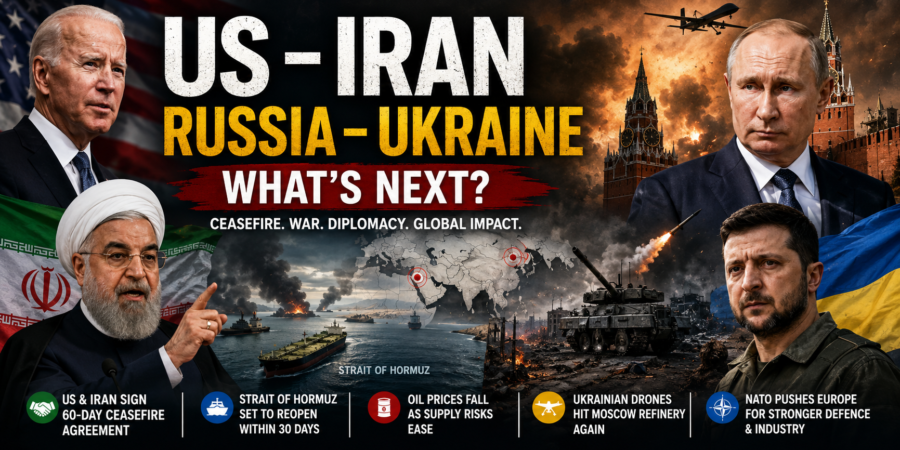
The US Iran Russia Ukraine news update 2026 is defined by a striking contrast. Washington and Tehran have signed a 14-point interim memorandum beginning a 60-day period for negotiating a final agreement. It also provides for commercial traffic through the Strait of Hormuz to move toward full capacity within 30 days.
Russia and Ukraine are moving in the opposite direction. Ukrainian drones again reached Moscow and struck the capital’s refinery, while Russian missile and drone attacks continued against Ukraine. Washington is simultaneously reviewing its European force posture, and NATO is pressing European allies to provide more forces, resources and industrial capacity.
What is confirmed—and what remains unresolved?
| Issue | Confirmed | Still unresolved |
|---|---|---|
| US–Iran framework | A 14-point memorandum starts a negotiation period of up to 60 days. | The final settlement, enforcement and sequencing of obligations still require agreement. |
| Strait of Hormuz | Commercial passage is to restart and traffic is targeted to recover within 30 days. | Insurance, security, mine clearance and commercial confidence may recover more slowly. |
| Iran’s nuclear programme | The memorandum addresses nuclear weapons, enriched material and international oversight. | Detailed limits, verification and sanctions sequencing remain difficult questions. |
| Russia–Ukraine war | Long-range drone and missile attacks continue against strategic and civilian infrastructure. | No comprehensive ceasefire or mutually accepted political framework has ended the war. |
| US role in Europe | Washington has announced a review of its military deployments and contributions in Europe. | The final effect on troops, aircraft, drones and NATO planning is not yet known. |
The US–Iran agreement: a ceasefire with a countdown clock
The interim memorandum is more than a pause in fighting, but less than a finished peace settlement. It creates a defined period in which Washington and Tehran must settle questions involving maritime security, sanctions, nuclear activity, frozen assets and future monitoring.
Its fastest global effect is economic. The Strait of Hormuz is one of the world’s most important energy corridors, so restrictions or threats to traffic can raise shipping costs, insurance premiums and fuel prices far beyond the Gulf. Oil prices fell after the agreement because markets expected lower supply risk and the gradual return of Iranian exports.
“One conflict has entered a 60-day diplomatic test. The other is measuring escalation through drone range, refinery damage and pressure on air defence.”
Why the nuclear question could decide whether the truce survives
Reopening a shipping route is visible: vessels either move safely or they do not. Nuclear compliance is more technical. Negotiators must define the treatment of enriched material, inspection authority, monitoring equipment, permitted activity and consequences for non-compliance.
The central sequencing problem is trust. Iran will seek dependable economic benefits and access to funds, while the United States will seek verifiable nuclear actions before making major sanctions relief permanent. Each side may fear fulfilling its obligations first and receiving too little in return.
That is why the agreement will ultimately be judged by implementation rather than the signing ceremony. Shipping security may deliver an early visible success, but the nuclear and sanctions negotiations will determine whether the process lasts.
Russia and Ukraine move deeper into the long-range war
While the Gulf moved toward negotiation, the Russia–Ukraine conflict intensified. Reuters reported that a large Ukrainian drone operation targeted Moscow and surrounding areas, striking the capital’s refinery for the second time during the week. The Moscow regional governor said 16 people were injured.
Ukraine describes refinery attacks as pressure on infrastructure supporting Russia’s war effort. Russia continues missile and drone operations against Ukrainian cities and energy systems. The military logic on both sides is to impose costs far behind the front line, but the result is a growing retaliatory cycle.
The strategic danger is not limited to the physical damage. Repeated attacks can disrupt aviation, fuel distribution, industrial output and public confidence. They also make diplomacy more difficult because each side faces pressure to answer the latest strike.
Washington’s European force review changes the NATO calculation
The United States is central to both theatres. It is a direct party to the Iran memorandum and the most powerful member of NATO. Every aircraft, intelligence platform, naval asset and air-defence capability allocated to one region affects planning elsewhere.
NATO Secretary General Mark Rutte said the alliance needs more forces, more resources and a much stronger industrial base, alongside fairer responsibility-sharing. The issue is not only defence spending. European governments must convert money into deployable forces, ammunition, air-defence interceptors, drones and production capacity.
For Ukraine, timing matters. A gradual and coordinated transition could increase European responsibility without creating immediate capability gaps. A rapid reduction in specialised US support could be much harder to replace.
The hidden connection: oil links all four countries
Energy is where the two crises most clearly intersect. Iran’s export access, Hormuz shipping, Ukrainian attacks on Russian refineries, sanctions on Moscow and US diplomatic decisions all influence the same global market.
For oil-importing economies, lower risk can reduce fuel and transport pressure. For Russia, lower prices could combine with sanctions and refinery disruption to weaken energy income. This gives the US–Iran agreement consequences well beyond the Middle East.
The wider policy connection is straightforward: easing one supply crisis can make it politically and economically easier for Western governments to increase pressure in another.
Three possible paths from here
These are analytical scenarios, not predictions or guarantees.
What readers should watch next
- Whether commercial traffic through the Strait of Hormuz increases without new security incidents.
- Publication of detailed nuclear, inspection and sanctions arrangements.
- The final results of the US review of forces and capabilities assigned to Europe.
- European decisions on air defence, ammunition, drones and defence production.
- Additional Ukrainian attacks on Russian refineries and Russia’s response.
- Oil prices, shipping insurance and the speed of Iranian export recovery.
Why this matters to students, travellers and ordinary families
These events affect daily life through fuel costs, food transport, inflation, airline routes, government budgets and currency pressure. A stable Hormuz route can reduce one source of uncertainty, while attacks on energy infrastructure in Russia and Ukraine create another.
International students and travellers should monitor official airline notices, embassy guidance and government travel advisories. Airspace restrictions can change quickly during regional escalation.
Readers should also verify dramatic social-media footage. Old videos are often recirculated as new, and military claims may appear before independent confirmation. Check the date, location, original uploader and reporting from multiple reputable sources.
Frequently asked questions
Is the US–Iran conflict completely over?
Has the Strait of Hormuz fully returned to normal?
Why did oil prices fall?
Did Ukrainian drones strike Moscow?
Is the United States leaving NATO?
Conclusion: one diplomatic opening, one widening war
The US Iran Russia Ukraine news update 2026 shows a global system moving in two directions. Washington and Tehran have created an opportunity to reduce risk in the Gulf, reopen a critical energy route and negotiate a broader settlement. Russia and Ukraine are demonstrating that long-range strikes can still widen the war’s geographic and economic impact.
The US–Iran process will be judged by safe passage, credible inspection, sanctions sequencing and enforceable implementation. In Europe, NATO burden-sharing and the US force review may reshape how deterrence and support for Ukraine are organized.
The next 60 days may show whether diplomacy can reduce one major source of global pressure—or whether unresolved disputes and military retaliation produce another period of escalation.
Sources and verification
This developing analysis was prepared from current Reuters reporting and official NATO material available on 18 June 2026. Wartime claims are attributed where independent verification may be incomplete.
Follow world events beyond the headline
Scholar News Hub explains major global developments that affect students, researchers, travellers and families through clear sourcing, practical context and regular updates.